
6 Projects That Will Transform the Chicago Suburbs Forever
Six major projects are reshaping the western Chicago suburbs right now. Some are already open, some are actively under construction, and a few are still more promise than reality. But each one tells us something important about where growth is heading across Aurora, Bloomingdale, St. Charles, and the corridor around O'Hare.
If you own a home nearby or are considering buying, it is easy to get swept up in the headlines. A new casino, tollway, entertainment district, apartment complex, or data center can sound like an automatic boost for home values. Real estate does not work that simply.
The biggest takeaway is this: base decisions on what is real, funded, and delivered, not on a shiny announcement or a future rendering.
1. Hollywood Casino Aurora: The Riverboat Comes Ashore
Aurora has replaced its 30 year old floating casino riverboat with a completely new land based resort near the I-88 interchange, right beside Chicago Premium Outlets. Penn Entertainment spent approximately $360 million on the nearly 19 acre development, making this one of the biggest completed projects in the western suburbs.
The new Hollywood Casino Aurora includes:
- More than 1,200 gaming positions
- A four star hotel with roughly 220 rooms and a spa
- Multiple restaurants, including a Giada De Laurentiis concept
- An Italian steakhouse, Asian noodle bar, food hall, and sports bar
- A 12,000 square foot event center
- A 1,000 car parking structure
- Approximately 700 jobs once fully staffed
The mayor has described it as Aurora's tallest building constructed since 1974. This is a major statement project for a city that already sits at the western edge of the I-88 technology corridor, sometimes called Silicon Prairie.
Why Aurora Needed a New Casino
For decades, Illinois law required casino gaming floors to sit above water. That is why Aurora's casino operated as a riverboat in the first place. When Illinois passed its gaming expansion law in 2019, existing riverboat casinos gained the ability to move onto dry land.
Penn Entertainment proposed the Aurora move in 2022. The reasoning was straightforward. The old riverboat had competition from expanding gaming options, including video gaming terminals and casinos outside Illinois. It was still generating revenue, but growth had stalled.
Over its lifetime, the old casino generated roughly $300 million in cumulative gaming taxes for Aurora. Before the move, annual gaming tax revenue was around $6 million and trending downward. The city was not simply chasing something new. It was also protecting an important existing revenue source.
The Casino Effect Myth
A new casino can support jobs, hospitality activity, restaurant sales, and local tax revenue. Aurora has been clear that these revenue streams can help reduce pressure on property taxes. That is meaningful.
What has not been established is a direct connection between the casino and higher nearby home values. No official source has claimed that buying near Hollywood Casino Aurora guarantees appreciation. If somebody is pitching the casino as a sure thing for your property's value, slow down.
There is another major item to follow downtown. Penn is required to demolish the former riverboat, its building, and the Fox River Walkway associated with that site. The public parking decks will remain, but there is no confirmed redevelopment plan yet for the old downtown riverfront location. That future project could become a much bigger factor for downtown Aurora than the casino itself.
2. I-490: The O'Hare Airport Connection That Is Not an Airport Entrance
The I-490 Tollway is probably one of the most misunderstood infrastructure projects in the Chicago suburbs. It has been talked about for years as western access to O'Hare, which naturally makes people think they will be able to drive directly into the airport from the west.
That is not what this project delivers, at least not initially.
I-490 is a new six mile north to south tollway along O'Hare's western edge. It connects I-294 near Franklin Park to I-90 near Des Plaines and links into Illinois Route 390, formerly known as the Elgin O'Hare Expressway.
The I-490 and Illinois Route 390 interchange alone carries a price tag of approximately $534 million. The wider Elgin O'Hare Western Access Program is around $4.3 billion in total.
Construction is unusually complex because the tollway must pass beneath O'Hare runway approach lighting systems. That requires four new bridges designed to elevate the approach lights without interfering with airport operations.
The key detail: O'Hare's currently planned western entrance is expected to be an employee parking area without public access. Future public amenities could happen if demand warrants them, but this is not a new traveler entrance into O'Hare.
What I-490 Actually Means for the Western Suburbs
It still matters. The project improves regional connectivity for freight, commuters, and businesses moving between I-90, I-294, Route 390, and O'Hare's west side. Communities such as Bensenville, Wood Dale, Itasca, Elk Grove Village, and Franklin Park have all been affected by years of construction and land acquisition tied to this corridor.
The I-490 connections at I-90 and I-294 were completed recently. The I-490 and Route 390 interchange remains under construction with a target completion in late 2027.
Still, this program has been in development for more than 15 years. Tollway mega projects can face real delays, so I would not make a home purchase decision based solely on a target date. Better regional access tends to draw demand toward well connected locations, but the timing matters just as much as the map.
3. The Grove in Bloomingdale: A Village Takes Control of a Dead Mall
Most municipalities do not buy a failed shopping mall. Bloomingdale decided that allowing Stratford Square Mall to sit vacant and deteriorate was the worse option.
Stratford Square closed permanently in April 2024 after years of decline. The village had already used tax increment financing districts in an effort to preserve the property. When that did not work, demolition began in October 2024. By 2025, the mall was gone.
Bloomingdale spent $17.1 million to acquire the mall's five anchor pads and interior mall space. Village officials openly acknowledged that buying retail real estate is not their usual business. They stepped in because the site was too important to let it become a long term dead zone.
The replacement is called The Grove, an approximately 80 acre open air mixed use district centered around a man made lake. Total project costs are estimated at around $78 million.
Plans include:
- Bloomingdale Yard, a roughly 100,000 square foot indoor sports and family recreation facility
- Lakeside dining and entertainment
- A dog park with a walk up bar
- A 280 unit residential building in the first phase
- More than 400,000 square feet of planned retail, dining, entertainment, and residential space overall
- A central event lawn for concerts, tournaments, and farmers markets
- A winter ice rink on the same central gathering space
Infrastructure work is expected to begin later this year, with Bloomingdale Yard and the first openings targeted for 2027. The village plans to retain ownership of some parking areas while selling individual pads to restaurants and retailers. In other words, Bloomingdale is taking on the role of master developer rather than handing the entire site to one private company.
There is no sales data yet showing what The Grove has done for nearby property values, because nothing has opened. Any claim about appreciation at this stage is speculation. What is clear is that a declining enclosed mall is being converted into housing, recreation, dining, and public gathering space. That is a far stronger long term use than an empty parking lot and a vacant department store.
4. Fox Valley 2.0: Aurora Reworks Its Mall One Piece at a Time
Aurora is taking a very different approach with Fox Valley Mall. Instead of wiping out the entire mall site, the city and its development partners have been converting vacant anchor spaces and underused parking areas into residential density one phase at a time.
The first major project was Lumen, a 300 unit residential building built on the former Sears parcel at the corner of Route 59 and East New York Street. The 11 acre site was redeveloped, and Lumen opened around 2022.
Then came Luca, announced by Focus Development in 2023. This phase includes a four story, 320 unit residential building and a senior community. Luca opened and welcomed its first residents recently.
That means nearly 840 residents are now living along this stretch of Route 59, even though the mall may look largely unchanged to anyone just driving past. Aurora and Focus Development have referred to this overall strategy as Fox Valley 2.0.
The broader Route 59 Corridor Plan considers closer connections between the Metra station and the mall area. A monorail link has even appeared in planning discussions, but there is no funding behind it. It is an interesting idea, not a current project.
The real story here is the adaptive reuse of land in a prime location. Dead retail anchor space is becoming homes. That is a practical way to keep a large mall district relevant without waiting for a single massive redevelopment plan to solve everything at once.
5. St. Charles: One Bright Spot and Two Major Question Marks
St. Charles' east side has three separate redevelopment stories unfolding at once. One is active and funded. The other two still carry substantial uncertainty.
Fox Haven Square Is Opening Now
Fox Haven Square is an eight acre dining and entertainment development at Main Street and Kirk Road. Pat Greco of G90 Family Partners is leading the project, and tenants have been opening on a rolling basis.
Fire and Wine and Sizzling EJs opened in early May. Rosebud Steakhouse is expected next, followed by additional concepts including Match House, Harbor House, a two story pickleball facility from Parker Hospitality, and Lou Malnati's.
This is a real example of revitalization that is moving from plans into actual openings. That distinction matters.
Charlestowne Mall Is Still Waiting
Right next door, Charlestowne Mall remains largely vacant. Only Von Maur and Classic Cinemas maintain exterior access, according to the city's current information. Most of the property belongs to the Krausz Companies, but no final redevelopment plan has been approved.
The mall has been through multiple unsuccessful redevelopment efforts under different owners for more than a decade. That makes it a useful reminder that a struggling retail property does not automatically become the next successful mixed use district simply because similar projects are happening elsewhere.
The Former Pheasant Run Resort Is Still a Concept
Further along Main Street, the former Pheasant Run Resort has also been cleared. The resort closed in 2020, and its remaining structures were demolished by around 2024.
SC Land has submitted a concept for the Shops at Pheasant Run, potentially consisting of 12 to 15 buildings across nearly 34 acres. The proposal includes retail, restaurants, a possible hotel, a bank, and a daycare. The developer is seeking $3.3 million in city incentives.
However, traffic concerns have already been raised during early city review. It remains a concept plan rather than an approved project. St. Charles has real momentum at Fox Haven Square, but the futures of Charlestowne Mall and Pheasant Run should not be treated as guaranteed.
6. The Data Center Boom Across Aurora and DeKalb
Data centers are changing how large parcels of land are being used across the western suburbs and beyond. These campuses are commonly built on broad, underdeveloped sites with strong electrical infrastructure, available fiber, acreage, and access to Chicago's technology and cloud computing network.
In Aurora, Edge Energy broke ground at Aurora Tech Park in 2023 with an initial capacity of 100 megawatts. Its first facility opened in early 2025, and a second Aurora facility was topped out in June, adding another 72 megawatts of capacity.
In DeKalb, Meta's campus south of I-88 became operational across 2023 and 2024. The project represents more than $1 billion in investment and supports several hundred jobs.
These projects can bring investment and commercial activity, but the conversation cannot stop there. Data centers also require immense electrical capacity.
An analysis from the Union of Concerned Scientists projects data centers could account for 64% to 72% of Illinois electricity demand growth through 2030. That analysis estimates the growth could add between $24 billion and $37 billion in system costs over the next couple of decades.
ComEd has separately filed a $15.3 billion grid plan with the Illinois Commerce Commission. If approved in full, ComEd has said residential customers could see monthly bills rise by approximately $2.50 to $3 beginning in 2028. Illinois lawmakers have held hearings on the issue, and this remains an active debate.
What to Evaluate Near a Data Center
Do not assume a data center nearby is automatically good or bad for home value. Instead, look at the details that actually affect daily life and future marketability:
- Zoning and surrounding land use: Find out what else could be built around the campus.
- Visibility: Consider whether large structures will be visible from the home or yard.
- Electrical infrastructure: Look for substations, transmission lines, and related utility improvements.
- Construction traffic: Major campuses can mean years of truck traffic and road work.
- Municipal tax agreements: Understand any tax abatement terms negotiated for the development.
What These Chicago Suburbs Projects Mean for Buyers and Sellers
When you look across all six projects, about half deserve close attention right now. The other half are worth monitoring from a distance until there is more certainty.
Hollywood Casino Aurora is open. The Lumen and Luca residential phases at Fox Valley Mall are open. Fox Haven Square is opening in real time. Those projects are delivered or very close to it.
I-490 remains under construction. The Grove in Bloomingdale is moving toward future infrastructure work and 2027 openings. Charlestowne Mall has no finalized redevelopment plan, and Pheasant Run remains at the proposal stage.
Once a project opens, the value it may bring is often already reflected in recent comparable sales. The initial investment figure might grab headlines, but buyers and sellers respond to what they can actually see, use, and evaluate.
Aurora, for example, already had one of the more competitive housing markets in the region before these projects arrived, with homes often selling in the mid $300,000s and moving from contract to close in 45 days or less. New development is being added to an already active market. It is not necessarily creating demand from nothing.
No city, developer, tollway authority, or operator connected to these projects has provided an official claim tying them directly to nearby home price appreciation. What they have documented is tax revenue, regional connectivity, job creation, and changes in land use. Those are all important factors, but none is a guarantee that a particular home will increase in value.
Announcements are cheap in the suburbs right now. What matters is what gets funded, built, opened, and sustained.
If you are buying near a project that is still under construction, there may be an opportunity to get ahead of a completed improvement. But that opportunity comes with timeline risk. If you are selling near a project that has already opened, use current neighborhood sales and buyer feedback, not big construction price tags, to understand how the market is responding.
|
FAQ
Will a new development automatically raise nearby home values?
No. Major development can improve amenities, jobs, tax revenue, or access, but none of those factors automatically produces higher home values. The timing of construction, the existing market, visibility, traffic, land use, and buyer demand all matter.
Can I-490 be used as a new public entrance to O'Hare Airport?
Not under the current initial plan. I-490 improves connections around O'Hare's western side, but the planned western entrance is expected to serve employee parking rather than provide a new public airport entrance.
When will The Grove at Stratford Square in Bloomingdale open?
Site infrastructure is expected to begin later this year, with early openings led by Bloomingdale Yard targeted for 2027.
What is Fox Valley 2.0 in Aurora?
Fox Valley 2.0 is the ongoing redevelopment of underused Fox Valley Mall land. It includes residential projects such as Lumen and Luca, which converted former anchor space and parking areas into new housing while the rest of the mall continues operating.
What should I research before buying near a data center?
Review local zoning, nearby utility infrastructure, visibility from the property, expected construction traffic, and municipal tax agreements. These specifics are more useful than assuming a data center will help or hurt a home's value.
Check out this article next
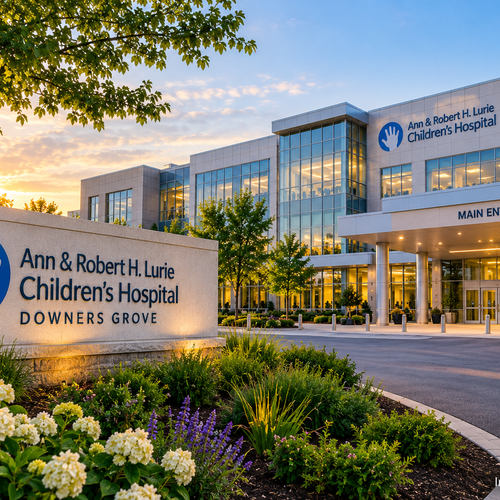
$480 Million Lurie Children’s Hospital Planned for Downers Grove
Lurie Children’s is planning a new $480 million pediatric hospital and outpatient center at 3300 Lacey Road in Downers Grove, near the interchange of I-88…
Read Article