A massive infrastructure project is quietly transforming the future of several fast-growing western suburbs.
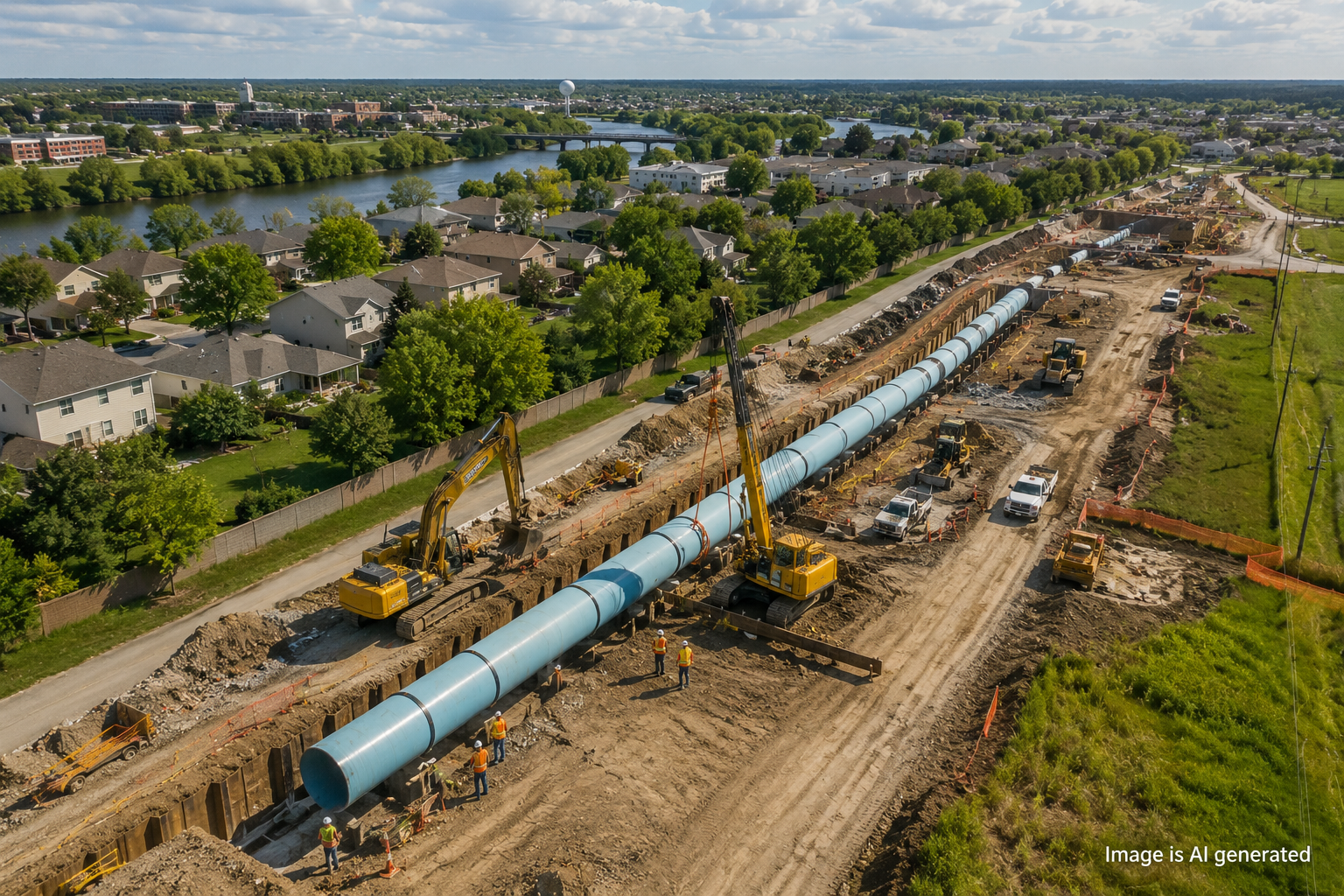
The WaterLink project, a nearly $400 million effort to expand Lake Michigan water service to Montgomery, Oswego, and Yorkville, is now well underway. The project includes approximately 30 miles of new water transmission pipeline and is expected to be completed in 2028.
While most residents may notice the project because of construction, road closures, and crews working throughout the area, the bigger story is what is happening underground—and why these communities decided they needed a new water source in the first place. ('Burbs Report by Living Chicago Suburbs)
A Nearly $400 Million Investment in the Western Suburbs
WaterLink is one of the largest municipal water infrastructure projects carried out in Illinois in roughly the last 30 years.
The project will extend the DuPage Water Commission's Lake Michigan water system westward, eventually serving Montgomery, Oswego, and Yorkville.
The pipeline will travel through multiple communities and jurisdictions, including portions of Naperville, before continuing toward Oswego, Montgomery, and Yorkville.
Some sections of the new transmission system will use pipes measuring as much as 54 inches in diameter. The project also requires crossings beneath or around major roads, railroads, utility corridors, and the Fox River.
Approximately 11 miles of the pipeline will use existing ComEd rights-of-way, helping reduce some of the construction challenges associated with the massive project. (Burns & McDonnell)
Why Do These Communities Need a New Water Source?
The answer comes down to growth—and the limits of the region's current water supply.
Montgomery, Oswego, and Yorkville currently rely on the Ironton-Galesville deep sandstone aquifer for their water supply. According to information cited by the WaterLink partnership, the aquifer is being withdrawn at roughly twice the rate at which it naturally replenishes.
As these communities continue to add homes, schools, businesses, and residents, officials have been increasingly concerned about whether the aquifer can support that growth over the long term.
Water officials have warned that the aquifer could face significant supply challenges as early as 2050, while some individual wells in Oswego could face problems sooner. (Burns & McDonnell)
Rather than waiting for the problem to become a crisis, the communities spent years studying alternatives before ultimately partnering on a regional solution.
Lake Michigan Water Will Support Future Growth
Once WaterLink is complete, Montgomery, Oswego, and Yorkville will transition to Lake Michigan water delivered through the DuPage Water Commission system.
The new system is expected to provide water service for approximately 90,000 residents, while also giving local schools and businesses a more reliable long-term supply. (Engineering News-Record)
For communities that have experienced significant residential development over the past several years, that reliability could become increasingly important.
New neighborhoods don't just require roads and schools. They also require the basic infrastructure that makes continued growth possible—including a dependable water supply.
What Residents Are Seeing Right Now
Although the finished system is still a couple of years away, construction is already visible throughout the area.
In Naperville, crews have been working along Book Road and near 95th Street and Wolf's Crossing Road as portions of the pipeline are installed.
The Book Road work has also resulted in road closures and detours that have affected local drivers. Construction in that area is part of the larger WaterLink system connecting into the DuPage Water Commission's existing network. (Positively Naperville)
As construction progresses, residents can expect additional work along the pipeline's route.
The Project Is More Than Just a Water Pipeline
At nearly $400 million, WaterLink represents a major investment—but its importance goes beyond the infrastructure itself.
The project is designed to give three growing communities a more sustainable water source while helping them plan for future population growth.
It's also an example of multiple municipalities working together on a problem that crosses community boundaries.
Montgomery, Oswego, and Yorkville each have their own governments and local infrastructure, but water doesn't stop at municipal borders. By creating a regional system, the communities are working together to address a challenge that affects all three.
The project is being funded through a combination of federal WIFIA financing, Illinois State Revolving Fund financing, and local general obligation bonds. Residents will continue to receive their water bills directly from their respective municipalities. (Burns & McDonnell)
What Happens to the Existing Wells?
The transition to Lake Michigan water doesn't mean the existing wells simply disappear.
According to project information, the current wells are expected to remain available for emergency backup use even after the communities transition to the new water source.
That gives the communities another layer of resilience as the new system becomes operational. (Burns & McDonnell)
Why Water Infrastructure Matters for the Chicago Suburbs
Infrastructure projects like WaterLink don't always get the same attention as new restaurants, downtown developments, or major residential projects.
But they can have an enormous impact on the future of a community.
Montgomery, Oswego, and Yorkville have all experienced substantial growth, and continued development depends on having the infrastructure necessary to support it.
A reliable water supply can help these communities accommodate future residents, businesses, and development while reducing their dependence on a groundwater source that officials say is under increasing pressure.
For people considering a move to the western suburbs, it's another reminder that the growth happening throughout the region isn't just about what's being built above ground. Some of the most important investments are happening underneath it.
FAQ
What is the WaterLink project?
WaterLink is a major regional infrastructure project that will extend Lake Michigan water service to Montgomery, Oswego, and Yorkville through approximately 30 miles of new transmission pipeline.
How much does the WaterLink project cost?
The project is estimated to cost nearly $400 million, making it one of the largest municipal water infrastructure projects in Illinois in approximately three decades. (Burns & McDonnell)
When will WaterLink be completed?
Construction is currently underway, with the overall project scheduled for completion in 2028. (Burns & McDonnell)
Why are Montgomery, Oswego, and Yorkville switching to Lake Michigan water?
The communities currently depend on the Ironton-Galesville deep sandstone aquifer, which is being withdrawn faster than it naturally replenishes. Officials determined that a new long-term water source would be necessary to support the area's continued growth.
Will the existing wells be shut down?
The communities are expected to retain their existing wells for emergency backup purposes after transitioning to Lake Michigan water. (Burns & McDonnell)
Final Thoughts
The WaterLink project may not be the most visible development happening in the Chicago suburbs, but it could end up being one of the most important.
With nearly $400 million being invested in a 30-mile pipeline, Montgomery, Oswego, and Yorkville are preparing for the next generation of growth—and making sure something as fundamental as clean, reliable water isn't overlooked.
For a region that's continuing to attract new families, businesses, and development, planning for the future means more than building new homes.
It means building the infrastructure to support them.
Check out this article next