
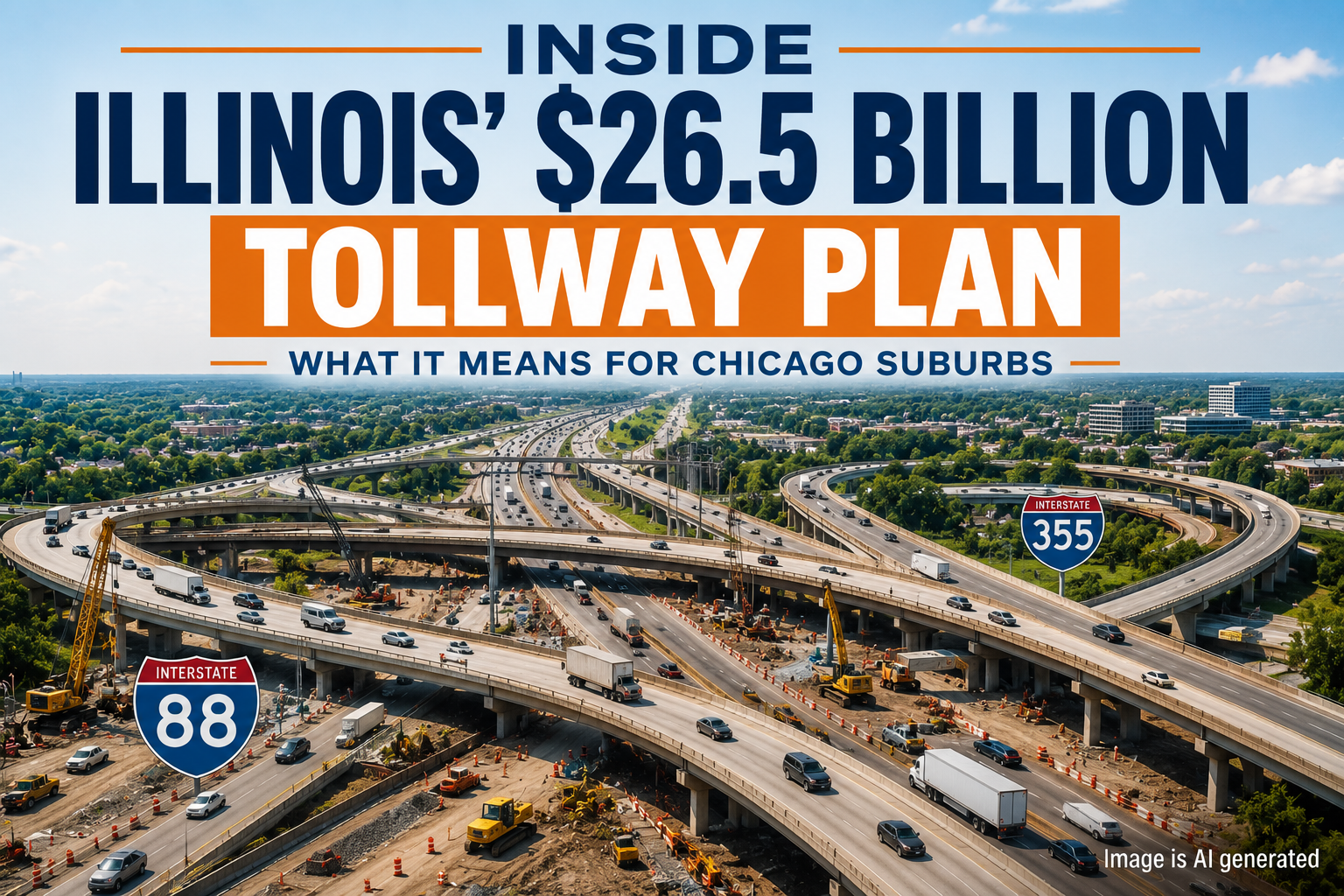
The Illinois Tollway has unveiled one of the largest infrastructure investment programs in state history—a $26.5 billion capital plan that will modernize some of the busiest highways in the Chicago region over the next 15 years.
From rebuilding aging roadways to redesigning major interchanges, the program aims to improve safety, reduce congestion, and prepare the tollway system for future growth. For residents of Chicago's western suburbs, many of the biggest projects will happen right in their backyard.
Here's what you need to know.
What Is the Illinois Tollway Capital Program?
The Illinois Tollway's new capital program is a long-term investment focused on rebuilding and modernizing existing infrastructure rather than constructing entirely new highways.
The proposed plan totals $26.5 billion and includes projects across the entire tollway system, including Interstate 88, Interstate 294, Interstate 355, Interstate 90, and areas surrounding O'Hare International Airport.
Many of these roads carry tens of thousands of commuters and freight vehicles every day, making them critical to both the regional economy and everyday travel.
The Biggest Projects Included
The plan funds hundreds of improvements, but several projects stand out.
I-88 / I-355 Interchange Reconstruction
One of the largest investments is a $3.1 billion overhaul of the I-88 and I-355 interchange in the western suburbs.
The project is expected to modernize one of the region's busiest highway connections, improve traffic flow, and reduce bottlenecks that regularly affect commuters.
Rebuilding Existing Toll Roads
More than $14.6 billion has been allocated toward reconstructing and rehabilitating aging toll roads throughout the system.
Many bridges, pavement sections, and supporting infrastructure date back decades and are approaching the end of their intended service life.
Interchange Improvements
An additional $3.36 billion is dedicated to upgrading interchanges across the region.
These improvements are designed to improve traffic movement, reduce delays, and enhance overall roadway safety.
Roadway Widening
Nearly $880 million will be used to widen selected sections of the tollway system where traffic demand continues to increase.
These projects are expected to improve travel times while accommodating future population and economic growth.
Why This Matters for Chicago Suburbs
Residents across Chicago's western suburbs rely heavily on toll roads for commuting, business travel, and freight movement.
Communities including Naperville, Downers Grove, Lisle, Oak Brook, Elmhurst, Wheaton, Aurora, Bolingbrook, and surrounding areas will likely experience the benefits of improved traffic flow as projects are completed.
Modernized highways can also make suburban communities more attractive for employers, distribution centers, and future economic development.
Economic Impact Beyond Transportation
The tollway program isn't just about smoother commutes.
Large-scale infrastructure projects often create thousands of construction jobs while supporting engineering firms, suppliers, contractors, and local businesses.
Improved transportation networks also help companies move goods more efficiently, an important advantage for one of the nation's busiest freight regions.
For residents and businesses alike, reliable infrastructure remains a key factor in long-term economic growth.
How Will the Plan Be Funded?
The proposed capital program would be funded through a combination of toll revenue, financing, and planned toll increases for I-PASS users.
While the proposed toll adjustments have generated discussion, tollway officials argue the additional revenue is necessary to fund decades of infrastructure improvements and maintain the system well into the future.
The funding plan will continue to be reviewed as projects move forward.
When Will Construction Begin?
The capital program spans approximately 15 years, with planning, engineering, and construction occurring in phases.
Some projects will begin sooner than others, while larger interchange reconstructions and roadway improvements will continue throughout the next decade.
Drivers can expect periodic lane closures, construction zones, and traffic changes as work progresses across the region.
FAQ
What is the Illinois Tollway's new capital plan?
It is a proposed $26.5 billion, 15-year infrastructure program focused on rebuilding and modernizing toll roads, bridges, and interchanges across northern Illinois.
Which highways are included?
Major projects affect Interstate 88, Interstate 355, Interstate 294, Interstate 90, and surrounding tollway corridors, including areas near O'Hare International Airport.
Why are these improvements needed?
Many portions of the tollway system were built decades ago and require reconstruction to improve safety, reduce congestion, and support future traffic demands.
Will tolls increase?
The proposal includes planned toll increases for I-PASS users to help fund the long-term infrastructure program. Final funding decisions will be made by the Illinois Tollway Board.
How long will the projects take?
The capital program is expected to unfold over approximately 15 years, with construction occurring in multiple phases.
Final Thoughts
The Illinois Tollway's proposed $26.5 billion capital program represents one of the most significant transportation investments the Chicago region has seen in decades.
While drivers may experience construction delays in the years ahead, the long-term goal is a safer, more reliable, and more efficient highway system that supports both commuters and the regional economy.
For residents of Chicago's western suburbs, these improvements could reshape daily travel and strengthen the transportation network that connects communities across the region for years to come.
Check out this article next