
One of the largest infrastructure projects in Illinois is officially entering its final stretch — and it’s happening right in the Chicago suburbs.
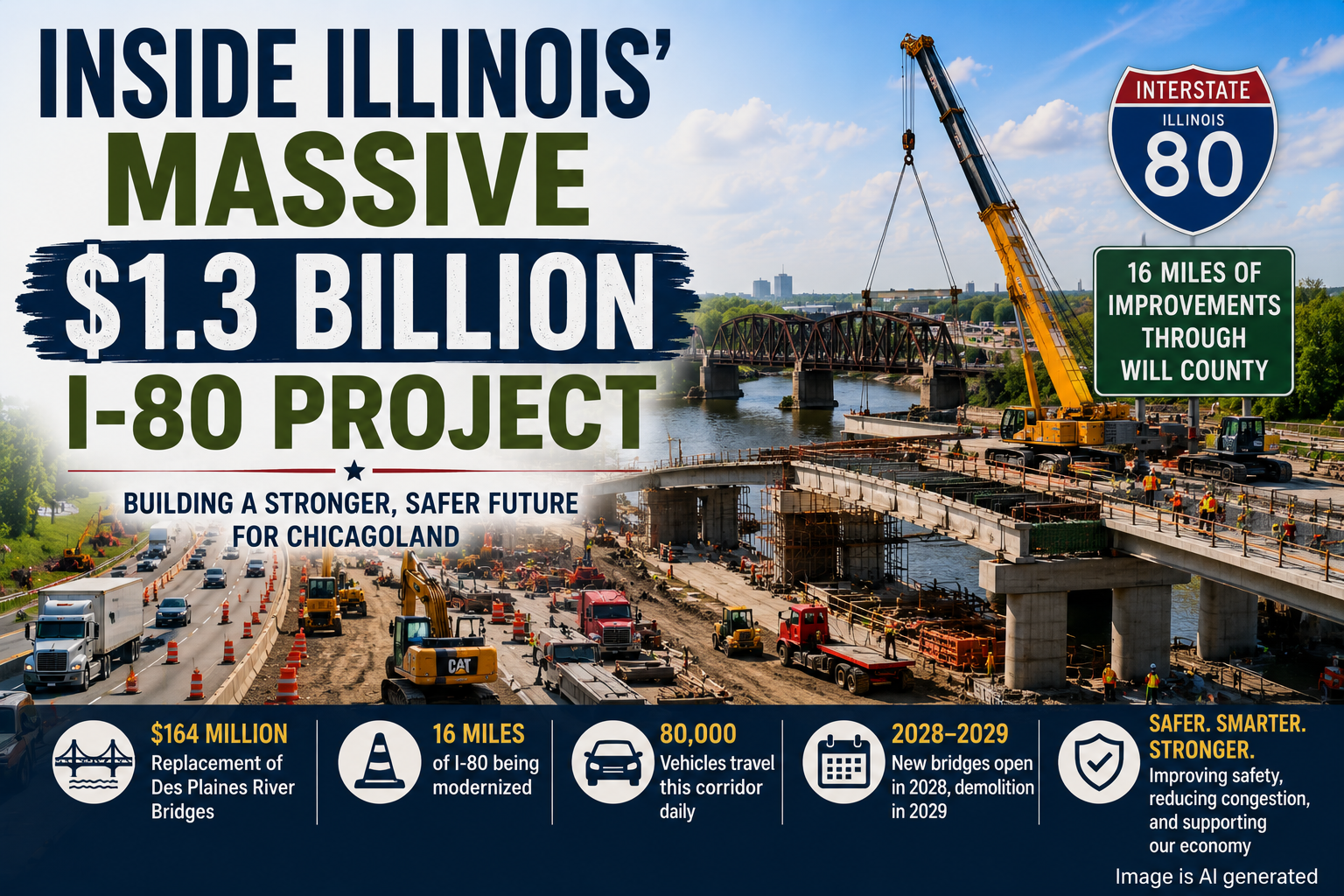
Construction is now underway on the $164 million replacement of the Des Plaines River bridges in Joliet, marking the final major phase of the broader $1.3 billion I-80 modernization project that has been transforming one of the busiest transportation corridors in the country.
For commuters, truck traffic, local businesses, and suburban communities throughout Will County, the project could have a major long-term impact on travel, safety, and economic growth across the region.
And because I-80 serves as one of America’s most critical freight corridors, the significance of this project extends far beyond just the Chicago suburbs.
Why the I-80 Corridor Matters So Much
Interstate 80 is one of the most heavily traveled highways in the United States.
The corridor running through Will County handles approximately 80,000 vehicles per day, including a massive volume of freight and commercial truck traffic moving across the country.
For decades, this section of I-80 has been known for:
congestion
bottlenecks
aging bridges
outdated interchanges
traffic backups
safety concerns
Many of the existing bridges and infrastructure date back to the 1960s and were never designed to handle the current level of transportation demand.
As suburban growth across Chicagoland accelerated over the years, traffic pressure on I-80 only continued increasing.
Now, Illinois is investing heavily in rebuilding the corridor for the future.
The Massive Des Plaines River Bridge Replacement
The newest phase of the project focuses on replacing the aging Des Plaines River bridges near Joliet.
The current bridges have become one of the most critical infrastructure concerns along the corridor due to both age and traffic demand.
Under the new plan:
two entirely new bridges will be constructed
the bridges will sit just north of the existing crossing
additional lanes will help improve traffic flow
modern safety improvements will be added
freight movement efficiency will increase
The bridge replacement alone carries a price tag of approximately $164 million.
Officials have described this portion of the project as:
the most complex phase of the entire I-80 modernization effort.
Construction on the new bridges is expected to continue through 2028, with demolition of the existing structures planned afterward in 2029.
What Else Is Included in the I-80 Modernization Project?
The broader I-80 project spans roughly 16 miles through Will County and includes major upgrades throughout the corridor.
Some of the improvements include:
additional travel lanes
rebuilt interchanges
upgraded ramps
improved safety features
modernized infrastructure
replacement of more than 30 bridges
freight traffic enhancements
Several major interchanges are also being reconstructed, including:
I-55
Larkin Avenue
Briggs Street
Drivers are expected to begin seeing portions of new third lanes opening by the end of 2026.
The goal is to improve:
travel times
freight efficiency
traffic safety
long-term regional mobility
Why This Project Is So Important for the Chicago Suburbs
While infrastructure projects rarely generate the same excitement as new restaurants or developments, projects like this can dramatically shape suburban growth for decades.
The I-80 corridor plays a huge role in:
regional commerce
logistics
industrial development
suburban job growth
commuter access
Will County in particular has become one of the country’s largest logistics and warehouse hubs thanks to its highway access and transportation infrastructure.
Major companies continue investing heavily throughout the region because of proximity to:
interstate systems
rail infrastructure
distribution routes
freight movement networks
Improving I-80 could further strengthen the region’s position as a national logistics powerhouse.
And for local residents, reduced congestion and safer roadways could significantly improve daily commuting experiences over time.
The Project Will Impact Drivers for Years
Of course, a project of this size also comes with years of construction impacts.
Drivers throughout the southwest suburbs can expect:
lane shifts
construction zones
temporary delays
changing traffic patterns
reduced speeds
occasional overnight closures
Officials say construction staging is designed to minimize major disruptions as much as possible while still allowing work to move forward efficiently.
Still, commuters who regularly travel through Joliet and Will County should expect ongoing construction activity through at least 2028.
Infrastructure Is Becoming a Bigger Focus Across Chicagoland
The I-80 modernization project reflects a broader trend happening across the Chicago region right now:
major reinvestment in infrastructure.
As suburban populations continue growing and freight traffic expands nationwide, transportation systems throughout Illinois are facing increasing pressure.
Projects like this are designed not only to address current congestion but also to prepare the region for:
future growth
increased freight demand
suburban expansion
evolving transportation needs
And because Chicagoland remains one of the country’s largest transportation hubs, infrastructure improvements will likely continue playing a major role in the region’s future development.
FAQ
How much is the I-80 modernization project costing?
The full I-80 modernization project is expected to cost approximately $1.3 billion.
What is being rebuilt on I-80?
The project includes:
new travel lanes
rebuilt interchanges
replacement bridges
upgraded ramps
safety improvements
modernization of more than 30 bridges
Why are the Des Plaines River bridges being replaced?
The existing bridges date back to the 1960s and no longer meet modern traffic demands or infrastructure standards.
When will the I-80 project be completed?
Major portions of the project are expected to continue through 2028, with some demolition and final work extending into 2029.
Why is I-80 so important?
I-80 is one of the busiest freight and transportation corridors in the United States and serves as a major route for both commuters and commercial transportation.
Final Thoughts
The massive I-80 modernization project represents one of the biggest infrastructure investments currently happening anywhere in Illinois.
While drivers may deal with construction frustrations over the next several years, the long-term goal is clear:
create a safer, more efficient transportation corridor capable of supporting future growth throughout the Chicago suburbs and beyond.
And once complete, the project could reshape commuting, freight movement, and regional development across Will County for decades to come.
Check out this article next