
Chicago Home Buyers BLINDSIDED By Hottest Market in America
Chicagoland is doing something that keeps catching buyers off guard. While national housing headlines talk about slowdown, caution, and uncertainty, this market has been moving on its own timeline.
That disconnect is the whole story right now.
Yes, the national headlines are telling the truth in a broad sense. Prices are still high. Inventory is still tight. Mortgage rates are still putting pressure on affordability. But if you apply that national story too literally to the Chicago suburbs and key city neighborhoods, you can end up making the wrong move at exactly the wrong time.
That is why so many buyers keep losing homes over the weekend. They assume they have time. In many of Chicagoland's hottest pockets, they do not.
Why Chicago Is Moving Differently Right Now
Chicago recently posted some of the strongest year over year home price growth among major metros in the country. That alone should tell you this market is not following the same script as Seattle, Los Angeles, or Washington, D.C.
There are a few reasons for that, and they are all stacking on top of each other.
1. Inventory is extremely tight
The biggest driver is still supply. Across the Chicago metro, the number of homes for sale remains well below normal levels. Illinois is dealing with a long-term housing shortage, and that shortage is not something that gets fixed in one selling season.
In fact, the state is short a massive number of housing units over the next several years if it wants to keep up with demand. And in some of the western suburbs, especially in DuPage County, there is a hard ceiling on how much new inventory can even be created. These are mature, built-out communities. They are effectively landlocked.
That matters because when demand shows up in a place with great schools, commuter access, walkable downtowns, and very little room to build, prices rise quickly.
2. The rate lock-in effect is real
A lot of homeowners bought or refinanced when mortgage rates were in the 3 percent range. Today, buyers are often staring at rates in the mid 6 percent range.
That changes seller behavior.
Many owners would like more space, a different neighborhood, or a new chapter, but selling means walking away from a very cheap mortgage and replacing it with a much more expensive one. So they stay put. That keeps resale inventory low, even when buyer demand is still active.
3. Chicago offers real value compared with other major cities
Chicago also benefits from being a true big-city market with a lower cost structure than many coastal metros. For remote workers and relocating buyers, the math can be compelling. More house for the money. Strong food scene. Culture. Major airport. Established neighborhoods. Commuter rail. Good suburban school systems.
That is not just abstract demand. It is real purchasing power entering the market.
Put all of that together and you get a market where the pressure is coming from three directions at once:
- Too little inventory
- Not enough new construction
- Owners staying put because of low existing mortgage rates
Why the Western Suburbs Are the Epicenter
If there is one region where this pressure shows up most clearly, it is the western suburbs.
These communities check the boxes buyers want most right now: top-rated schools, commuter rail access, walkable downtowns, established housing stock, and a sense of place that newer outer-ring developments often cannot replicate.
And because so many of these suburbs are fully developed, low inventory is not a temporary inconvenience. It is structural.
Downers Grove: The Market That Catches Buyers Off Guard
Downers Grove is one of the clearest examples of how appearance and market speed can be totally out of sync.
On the surface, it feels classic and settled. Mature trees. Craftsman bungalows. Brick colonials. A charming downtown anchored by the Tivoli Theatre. It does not look like the kind of place where a home can hit the market on a Thursday and be gone by Sunday afternoon.
But that is exactly what happens.
Detached single-family homes here are generally trading in the upper 500s, and appreciation has been strong. Homes are often going pending in about a week on average, and the most desirable properties move even faster.
The main drivers are easy to see:
- Strong schools, especially District 58 and District 99
- Excellent rail access with Main Street and Fairview stations on the BNSF line
- A true downtown lifestyle that people actually use during the week, not just on weekends
The key thing to understand about Downers Grove is that it operates at two speeds.
Updated homes in the right location, especially near strong schools and commuter access, can attract multiple offers almost immediately. Homes with deferred maintenance or weaker positioning can sit longer. That split is important because it creates opportunity for prepared buyers who know what they are looking at.
If you have been losing multiple offer situations, these slower listings may be the part of the market worth targeting.
Naperville: The Gold Standard, and the Price Tag Reflects It
Naperville has been desirable for years, and the competition reflects that.
This is one of those suburbs that shows up on every ranking list for a reason. It has nationally recognized schools, a well-known downtown, strong commuter access, parks, trails, and the kind of all-around lifestyle package that keeps demand steady no matter what rates are doing.
Pricing varies a lot by pocket. Some neighborhoods start in the high 500s, while many move much closer to 750,000 or 800,000. In certain areas, especially near downtown, prices climb well beyond that.
Two things especially drive buyer confidence here.
School districts 203 and 204
These districts are a major reason Naperville continues to command premium pricing. They have deep reputations, broad academic strength, and the kind of consistency that buyers trust.
Infrastructure and lifestyle
Naperville has two BNSF stations, strong express service into Chicago, a major park system, and the Riverwalk, which remains one of the most recognizable lifestyle amenities in the suburbs. It is not just attractive on paper. It shapes daily life in the community.
Naperville works especially well for buyers who are nervous about buying in a shifting market but still want a suburb with durable demand. The reasons people buy here are not temporary. That is what makes it stable. It is also what makes it expensive.
Wheaton: Established, Competitive, and Quietly Intense
Wheaton sits at a different price point, but the buyer profile is similar in one important way: these buyers tend to know exactly why they are there.
A lot of them are moving up. They may be coming from a condo in the city or a starter home in an inner-ring suburb. They want more yard, stronger schools, and a downtown they can actually enjoy on a Friday night without getting in the car.
Wheaton gives them that.
Detached single-family pricing often lands in the mid 400s, though competitive homes can blow past list price. It is not unusual for well-positioned listings to draw aggressive offer activity, especially in the 500,000 range where buyer demand can be intense.
Wheaton stands out for several reasons:
- Top-rated schools
- Two Metra stations on the Union Pacific West line
- A historic downtown with restaurants, shops, and community activity
- A stronger sense of history and identity than many newer suburbs
This is also a market where the sorting is very clear.
Updated kitchens, modern finishes, working mechanicals, and clean condition are commanding premiums. Dated homes, even in strong neighborhoods, are getting more resistance than sellers sometimes expect. The market is active, but it is not forgiving.
Hot Chicago Neighborhoods Buyers Should Not Ignore
Even though the western suburbs are the core of this story, some of the sharpest moves in Chicagoland are happening inside the city as well.
West Loop
The West Loop, especially around Fulton Market, remains one of the strongest downtown condo markets. Buyers are drawn to walkability, restaurants, and proximity to major employment corridors. Supply is tight, demand is steady, and the best units are not lingering.
South Loop
The South Loop shows a similar pattern. Average pricing may look moderate compared with some other neighborhoods, but averages can hide what is happening on the competitive end. Strong listings are still commanding above-list offers.
Logan Square
Logan Square is one of the clearest city examples of a market that looks calmer on paper than it feels in real life. Buyers come here for restaurant access, Blue Line convenience, vintage housing stock, and neighborhood character. Days on market can appear reasonable, but desirable homes still move quickly enough to punish hesitation.
This is another place where buyers who think they have two weeks to decide can learn otherwise very fast.
Bronzeville
Bronzeville deserves a more nuanced read. Prices are still relatively accessible by Chicago standards, but the bigger story is the development pipeline. Major redevelopment activity, new public infrastructure, and trail investment are reshaping the area's future.
That creates upside, but it also means buyers need to go in with a clear understanding of what is established today versus what is still emerging.
Outer-Suburb Outliers Worth Knowing
Two markets outside the usual western-suburbs conversation are also worth paying attention to.
Frankfort
Frankfort offers larger lots and a charming small-town feel at prices that would often buy less in DuPage County. For buyers willing to trade some proximity for space and value, it can be a compelling option.
Deerfield
Deerfield is the quiet outlier that proves this heat is not just a DuPage County story. Homes there are moving quickly, offer activity is strong, and appreciation has been impressive. The same formula keeps showing up: transit access, highly regarded schools, and walkable character.
What It Takes to Win as a Buyer Right Now
The buyers winning in this market have one thing in common. They are not shopping based on national assumptions. They are shopping based on the exact submarket they are in.
If you are going after a well-priced, updated home in a top suburb or a strong city neighborhood, here is what matters most.
Get fully pre-approved, not just pre-qualified
This is non-negotiable. In a fast-moving market, a pre-qualification is not enough. Sellers want to know your lender has verified your income, assets, and credit. If your paperwork is loose, your offer is weaker before anyone even looks at price.
Know your ceiling before you enter the house
This market punishes indecision and emotional bidding.
You need a walk-away number before the showing starts. That number should come from local comparable sales and your budget, not from adrenaline after five other buyers show up at the open house. In many of these western suburbs, strong homes are still going 25,000 to 100,000 over asking depending on price point and condition.
Understand the cost of waiting
Waiting can be a strategy, especially if you are hoping for a calmer fall or winter market. But waiting is not free.
Prices across the metro have risen dramatically since 2019, and the underlying housing shortage has not been solved. In the most competitive submarkets, a major correction is far from guaranteed. That means buyers need to weigh possible seasonal opportunities against the risk of paying more later.
Target the split in the market
Not every listing deserves a bidding war.
In places like Downers Grove and Wheaton, there is a clear divide between turnkey homes and listings with deferred maintenance. If you keep losing the polished homes everyone wants, the smarter move may be to focus on the properties that need a little work but are still in strong locations.
What Sellers Need to Understand Right Now
If you are selling in one of Chicagoland's tighter markets, you may have more leverage than you think. But leverage does not mean you can ignore strategy.
Pricing still matters, even in a hot market
A strong market does not protect an unrealistic list price. Buyers are stretched on monthly payment already, and they are comparing your home to nearby sales carefully. The right price can create momentum and competition. The wrong price can leave even a good home sitting longer than it should.
Condition matters more than many sellers realize
Buyers are already taking on high rates. Many do not want to close and immediately start paying for a new roof, HVAC system, kitchen remodel, or cosmetic overhaul. That is why updated and well-presented homes are getting real premiums.
If you invest in presentation before listing, you open the door to the full buyer pool. If you list a dated home at an optimistic number, you narrow that pool fast.
Know your actual submarket
Not every suburb and not every neighborhood is moving at the same speed. Logan Square is not Wheaton. Wheaton is not Naperville. Naperville is not Bronzeville. The details matter.
The sellers who do best are the ones who understand whether they are in a true frenzy segment, a split market, or a more patient one.
The Big Takeaway
The gap between the people winning in this market and the people getting blindsided is smaller than it looks. Usually, it comes down to expectations.
If you think Chicagoland is behaving exactly like the national housing story, you are more likely to hesitate, underprepare, or price incorrectly.
If you understand which neighborhoods are moving fast, why the western suburbs remain the epicenter, and how sharply this market is sorting between the right homes and the wrong ones, your odds improve quickly.
That is the real story in Chicago right now. It is not just that prices are high or inventory is low. It is that some of the most desirable parts of this market are still moving with real urgency, even while the broader national conversation suggests something softer.
And until supply meaningfully improves, that tension is likely to stay with us.
FAQ
Why are Chicago home buyers getting blindsided right now?
Because many buyers are relying on national market expectations in a region that is moving differently. In some Chicago suburbs and neighborhoods, desirable homes are receiving multiple offers within days, not sitting for weeks.
Which Chicago suburbs are moving the fastest?
Some of the fastest-moving western suburbs include Downers Grove, Naperville, and Wheaton. Each has strong schools, commuter rail access, and established downtowns that keep demand high.
Why are the western suburbs so competitive?
They combine many of the features buyers want most: top-rated schools, Metra access, walkable downtown areas, mature housing stock, and very limited room for new construction. That creates persistent supply pressure.
Is Downers Grove really that competitive?
Yes. Updated single-family homes in strong locations can go under contract in just a few days, often with multiple offers. The market can look calm from the outside, but the best homes move fast.
What makes Naperville so expensive?
Naperville has deep and durable demand drivers, including highly ranked school districts, commuter rail access, a strong park system, the Riverwalk, and a well-established downtown. Buyers pay a premium for that overall lifestyle package.
Should buyers wait for the market to cool down?
Waiting can make sense in some cases, especially if seasonal slowdown creates better opportunities. But in Chicago's most competitive submarkets, waiting also carries the risk of higher prices and continued low inventory.
What do buyers need to do to compete in this market?
Buyers should be fully pre-approved, understand the exact submarket they are targeting, set a walk-away number before touring homes, and move quickly when the right listing appears.
Are sellers still in a strong position in Chicagoland?
In many high-demand suburbs and neighborhoods, yes. But sellers still need to price correctly and present the home well. The market is rewarding updated, move-in-ready homes much more than dated ones.
Check out this article next
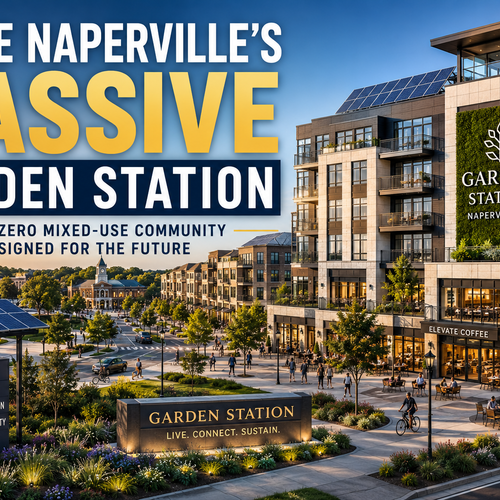
Inside Naperville's Massive Garden Station Development
A major new development could soon reshape part of downtown Naperville while putting the city on the national map for sustainable urban living...
Read Article